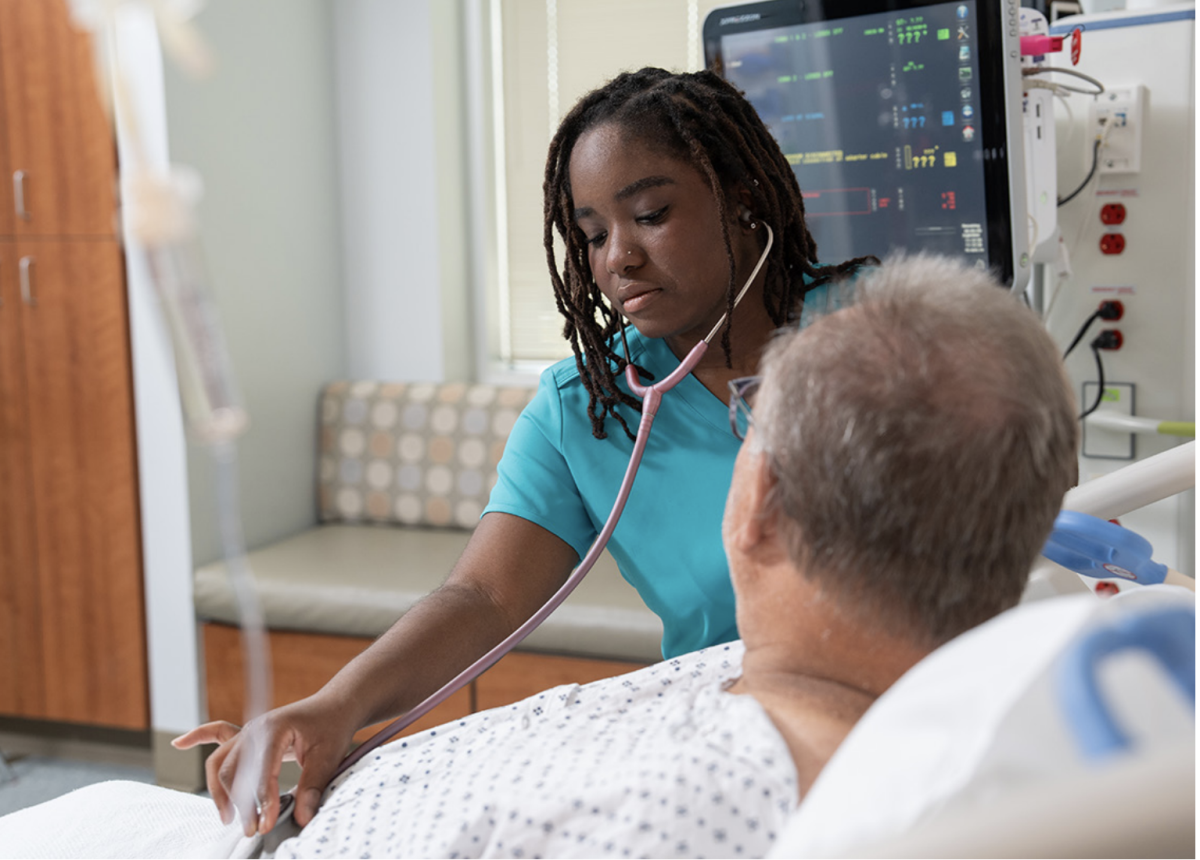
The Conway Medical Center College of Health and Human Performance at Coastal Carolina University received $2.4 million in funds to enhance hands-on training for students.
Supported by Sen. Lindsey Graham, this fund has been credited to support the creation of the Advanced Nursing and Health Sciences Simulation Laboratory, where the equipment will be accessible for both nursing and health science majors.
The new laboratory will provide realistic and high-quality clinical experience in a risk-free environment to strengthen students’ clinical skills and patient care readiness.
“We don’t take lightly that we are going to have students who are caring for someone that someone else loves, and so our dedication and our responsibility to the public is our primary focus and making sure that these students have the skill set to be able to go out and provide that care is imperative,” Nursing and Health Sciences Chair Susan Montenery said.
Montenery oversees the Registered Nurse (RN) and Bachelor of Science and Nursing (BSN) programs, the pre-licensure program and all the health science students. She explained how students need an environment where they can gain hands-on experience, practice, gain confidence and take their time learning new skills.
“It not only provides the practice for them, but it allows them to make connections to be able to take those out into a clinical setting and feel good about being able to do those things,” Montenery said.
Montenery said this funding provides the opportunity for students to be able to learn on a variety of platforms. These platforms include standardized patients, high-fidelity mannequins, wearable technology or VR headsets. Either way, students will experience diverse learning.
Colleen McGlone, the dean of Conway Medical Center College of Health and Human Performance, discussed the challenges upon launching CCU’s fouryear traditional Bachelor of Science in Nursing degree.
‘‘With the launch of that program with our second cohort admitted we are working in a very small space. Our faculty’s doing amazing, but we’re also limited in how much equipment we have,” McGlone said.
She elaborated on how South Carolina has one of the highest healthcare and nursing shortages in the nation, especially in impoverished and rural areas.
Writing the grant proposal herself, McGlone shared how this funding will help the college get state-ofthe-art simulators and wearable technologies. The high-fidelity mannequins will be programed to do a variety of things from screaming, giving birth and even bleeding out. She stated that the college will purchase this for students to have more human interaction insights.
This technology will also be integrated into augmented and virtual reality platforms, allowing students to put on headsets and enter a simulated patient room. Within this immersive environment, they can practice moving around the bedside, performing clinical tasks and responding to various scenarios.
McGlone explained that patient outcomes are improved when students enter the field with prior experience and thorough preparation. By the time they earn their licenses and begin working within the healthcare system, they have already practiced hands-on skills repeatedly.
“Our students make a positive impact on so many generations whether it’s in nursing, whether it’s in public health, whether it’s exercise science, recreations sports management, that is our goal is to train students to be a positive impact in people’s lives. And so, this is going to be another way that we can enhance that vision and that goal,” McGlone said.
Molly Jenkins, a freshman nursing major said this funding is important because it shows how much the school cares.
“I think it shows that they care about the standard of care and the standard of education here at Coastal for the nursing majors and health science majors,’’ Jenkins said.
Ryan Turner, a freshman prenursing major explained that given the current nursing shortage in healthcare, these funds strengthen the education and training of future nurses.
‘‘I think it can provide better research opportunities, or better opportunities for students to get more hands-on learning in healthcare and provide better hands-on learning opportunities with the models that we use in school,” Turner said.