Three faculty members from out-of-state public universities left with new ideas from Coastal Carolina University’s 2026 Sustainability Symposium.
CCU Political Science Professor Pamela Martin invited fellow American Association of State Colleges and Universities (AASCU) colleagues to participate in the symposium panel she organized and monitored, “Sustaining Our Shared Spaces: Stewardship of Public Lands and the Next Generation.” Teaching Specialist Erin O’Hanlon from Stockton University, Manager of Sustainability Aysha Bodenhamer from Radford University and Vice Chancellor for Academic Affairs Harald Barkhoff from the University of Hawaiʻi – West Oʻahu all accepted Martin’s invitation, traveling from New Jersey, Virginia and Hawaii, respectively.
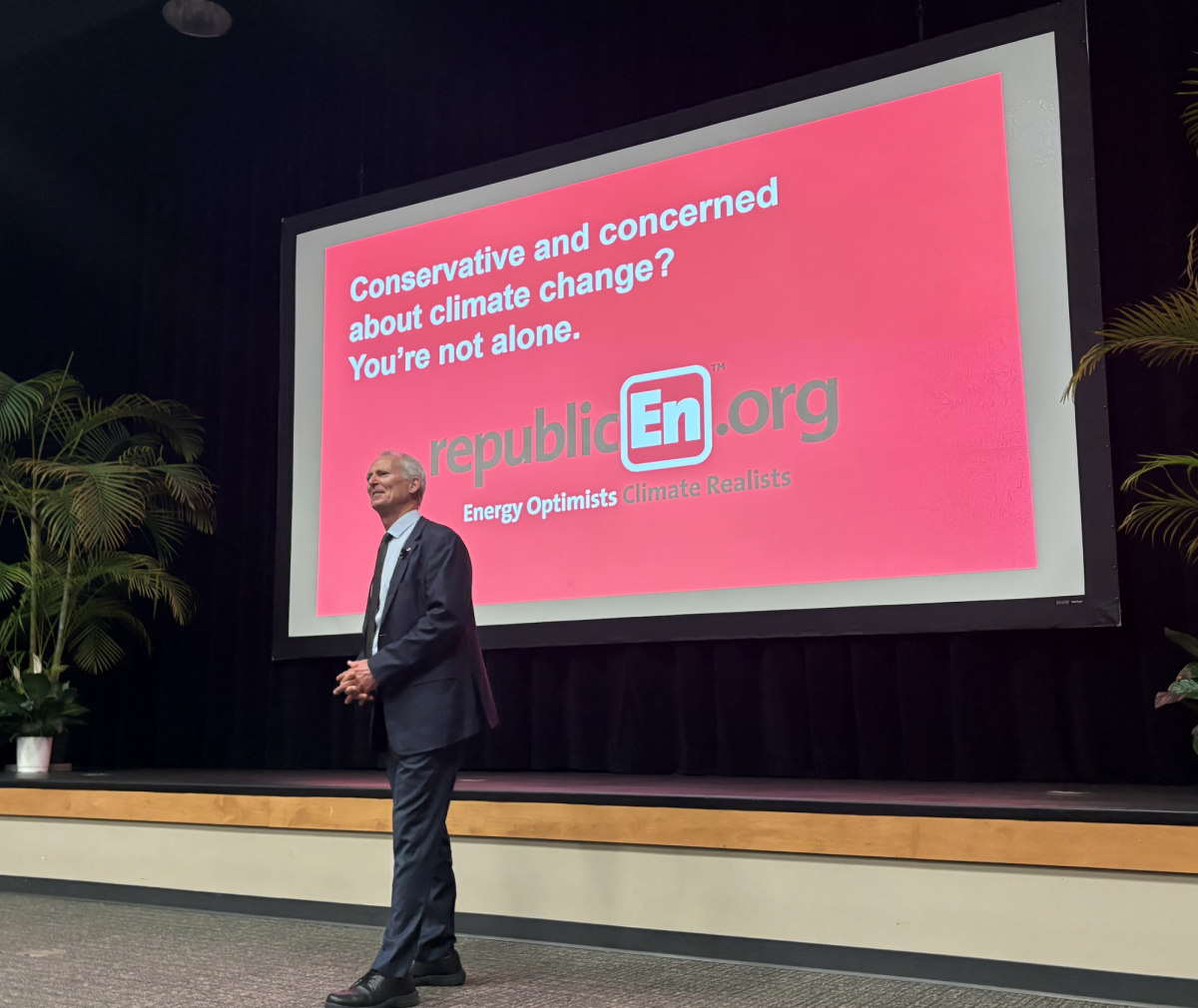
An hour before participating in their own panel, the three visitors watched former South Carolina congressman Robert “Bob” Inglis present at the symposium as well. Inglis shared his argument for supporting a federal carbon tax, his approach to fighting climate change as a Republican and bridging the gap between political parties when discussing environmental policies.
The group listened to Inglis’ presentation attentively, took notes and participated in live polling activities before sharing their own diverse responses to environmental topics next.
After meeting at a program experience at Glacier National Park last summer, the AASCU group reunited to share with Coastal’s audience how appreciating, protecting and connecting to public land can look different across state and county lines, as well as across fields of study.
“I teach within education and human development, and so my piece and my contribution particularly around stewardship of public land … you know, looks very different. But I think that’s the beauty of a model like that: it’s so scalable that it can look in a completely different way in New Jersey than it can in South Carolina,” O’Hanlon said. “We understand sort of that stewardship, that responsibility, that connection — again, you know, so intradisciplinary — and we approach it from so many different frameworks.”
The panelists discussed a wide range of matters such as preserving public lands at the Waccamaw National Wildlife refuge, fostering indigenous graveyards in Galloway, New Jersey, operating on the New River banks in Radford, Virginia and utilizing public lands on university grounds to benefit the campus and community of Kapolei, Hawaii.
“I think the power of it all was to encourage everyone to look at their own communities and identify what are some areas of concern to you? Or what are some areas where you can volunteer or do research projects or just become more involved? I think that’s really the ripple effect of the democracy project [AASCU American Democracy Project] is to just encourage folks to get involved and do more,” Bodenhamer said.
Despite the distance and differences, the panelists found they have more in common than some may expect.
“In Hawaii, it’s very linked to indigenous cultures, and so the way they steward their public lands is by engaging community. And we do the same thing in South Carolina with our indigenous and Gullah Geechee peoples. There are public lands associated in their communities,” Martin said. “And so, we not only have a natural heritage, but that natural heritage of land and water is connected to our cultural heritage, just like it was in Hawaii.”
The panelists attended other symposium events before and after their own panel, later acknowledging how Coastal exceeded their expectations.
“I mean, there were biologists, geologists, sociologists; there were folks who focused on sustainability. There were folks who were focusing on policy and research, political science. There was such a broad range of faculty and disciplines there and I’m just not sure that it is fully appreciated in the larger community and off campus,” O’Hanlon said. “Most sustainability processes and most sustainability conferences tend to be very scientifically focused; they might have particular themes. The interdisciplinary work of that one was so rich. [I’m] just really struck by that.”
Throughout the symposium, the AASCU group members found specific ways that the Coastal community is involved in sustainability and conservation that they found inspiring.
For example, members of the Eddy Lake Cemetery Project in Bucksport, South Carolina, have marked with small pink flags previously unmarked gravesites that were discovered and believed to have belonged to Bucksport residents and enslaved peoples.
O’Hanlon specifically noted the impact of learning about the Eddy Lake Cemetery Project, and how she appreciated the intention to recognize members and ancestors of the community with the gravesite markings.
“We also have some — I would say a lot of — communities that were founded by freed slaves. They have graveyards that are in disrepair. There are community folks who are trying to foster them, but those community folks are themselves aging,” O’Hanlon said. “And so I thought that was a really great project and just the fact that there was the ability to put down markers, doesn’t necessarily say who that person is, but just that there was an indication that someone was buried there and that people will respond and respect that space in a different way because of that.”
Bodenhamer shared how her coastal symposium experience could impact plans for Radford University as well, following their own recent conservation conference and the official start of composting on campus for the first time.
“I love a smaller, more intimate conference like that, and I have long wanted to do something like that at Radford. So, for me, it was inspirational just to see how they had organized it,” Bodenhamer said.
After a full day of panels and discussion, all members said they were encouraged to continue growing their own campus sustainability methods and working together in the future.
“I feel very fortunate to be at a university that supports initiatives like the Sustainability Symposium and so many other things that Sustain Coastal and the President’s Council on Sustainability and Coastal Resilience do. I think it just highlights the niche that Coastal Carolina University has in the areas of sustainability and coastal resilience,” Martin said. “I think it’s a really special day when faculty, staff, and students and guests can all be together, sharing important initiatives and research and ideas, and also sharing meals together at the same table.”