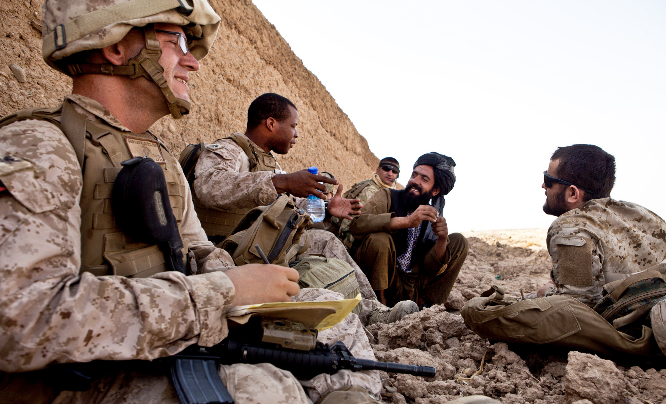
As the war between the U.S., Israel and Iran continues, Coastal Carolina University student veterans shared their own experiences and personal thoughts on the conflict.
Jabrier Lee a first-year psychology major served in the U.S. Air Force for four years and was deployed to Kandahar, Afghanistan in 2013, before sustaining disability.
Lee said that one of President Donald Trump’s biggest talking points when running for a second term was that he said he wouldn’t be engaging in more warfare.
However, Lee said he feels Trump has involved the U.S. military in this war for resource access and in turn monetary gain.
Lee also said that despite verbal threats, Iran has not been a major threat to the U.S. in the past 30 years, and the war could last forever, unless Americans make a stand to a war the U.S. doesn’t want to be in.
“This war is about oil. So, I think it’s pretty unfair. We shouldn’t be fighting in this war,” Lee said. “And for us to basically throw the first punch is and say that we were being threatened is weird. I think the only way it will have to end is we have to stop giving Israel so much power influence in our nation and to be fair, instead of trying to bully the rest of the world.”
David Brownfield, a finance major graduating next year, began serving in the U.S. Navy in 2008 as a Hospital Corpsman, which he compared to a Combat Medic. Brownfield spoke about Iran’s long history with the U.S., and his own experience with their weaponry.
“When I was in Afghanistan, all of the rockets that rained down on us and all the IED’s that we found were all provided by Iran,” Brownfield said. “So, what I like so far is it doesn’t seem like we’re trying to take over Iran. It seems like we’re really just trying to degrade their military capabilities. So, I am in favor of that because they seem to be the main sponsor of anti-Western antagonization in the Middle East.”
Brownfield said that since the wars in Iraq and Afghanistan, both the Trump and Biden Administrations were reluctant to put large forces on the ground, anywhere. Because of this, Brownfield said he thinks it would be Iran best interest to make peace.
“I think the most likely thing, just for political reasons but also just strategically at a certain point, Iran gets to the point where ‘we sort of have to make some sort of lasting peace with the U.S.,’” Brownfield said. “So, I would think if I had to bet money, if I were forced to bet a hundred dollars, we’re [the U.S. and Iran] within two months of a cessation of operations.”
Junior anthropology major Christopher Kittle served eight years in the Army, two of which were with the Myrtle Beach reserves and six years of active duty. “I mean, I don’t think we’ve made this decision. I think we were coerced into this, forced into it. I don’t think this is something that we were ready to do,” Kittle said.
Kittle said that Trump sending marines to the Middle East is a sign that the war has escalated, and he fears American soldiers will die as a result.
“If we put boots on the ground; that’s going to be the quicksand that pulls us into another forever war like Afghanistan and Iraq, and we’re rapidly approaching it. Because the moment boots are put on the ground like that, I hate saying it bluntly like this, but Americans are going to die,” Kittle said.
Kittle said Kharg Island, Iranian territory, holds 90% of Iran’s oil exports and that according to The Atlantic, Trump has discussed sending troops to the island.
“Iran’s been building and buying hundreds of thousands of drones and munitions and stuff of that nature. And we have not, so we don’t have a drone deterrent. We don’t have ways to protect our troops,” Kittle said. “If they decide to send drones over onto that island, they’ll [U.S. soldiers] be screwed. They’ll be sitting ducks.”