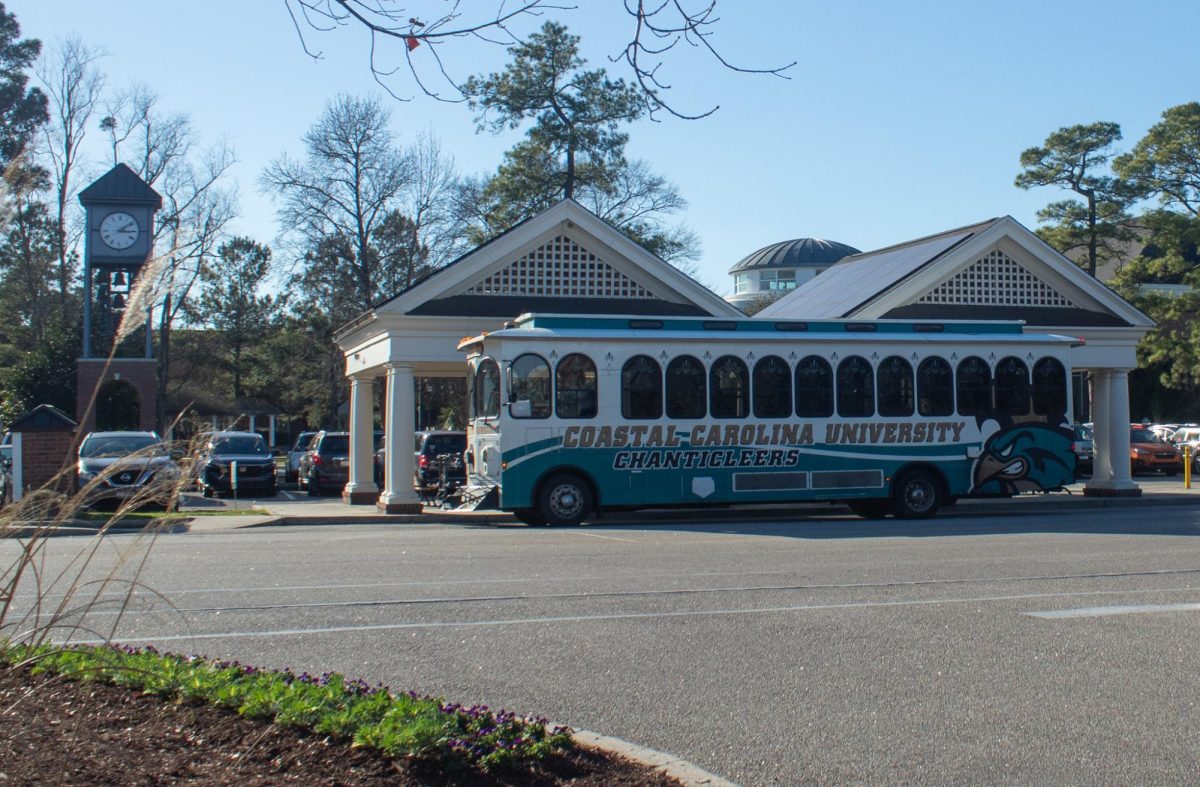
The sudden change in Coastal Carolina University’s shuttle transit system has students and faculty struggling with adjustment, but university officials are confident in a smoother daily routine to come.
After years of familiarity, shuttle route changes and updates this academic year have left students and faculty on their feet, to say the least. Still confused with last semester’s sudden removal of the Lib Jackson Student Union (LJSU) shuttle stop, students returned this spring to find the stop return as the “Union Hub,” along with another transit system update. Sandy Baldridge-Adrian, the associate vice president of Auxiliary Enterprises, spoke with The Chanticleer to clear the air.
Baldridge-Adrian explained how the university commissioned Stantec Consulting Services Inc. to conduct a professional multimodal mobility study, now in the process of final review. According to Coastal Carolina University’s official website, during the Fall 2024 semester, Stantec gathered nearly 2,000 survey responses regarding campus mobility.
In addition, Stantec observed campus for several days and busiest times such as first week of classes and home football gamedays, met with stakeholder groups and collected traffic data. Baldridge-Adrian said Stantec has been communicating their findings and recommendations, which has guided the university’s recent implementation of changes thus far.
Explaining the transit changes of last semester, Baldridge-Adrian said it was evident students wanted shuttle stops on the west side of campus, referred to her as “the side with athletics.” In response, the university added a shuttle stop at the TD Sports Complex, but removed the shuttle stops associated with the student union and Penny Hall to keep shuttles on the road and wait times low.
“It was more efficient, created less stops, less traffic lights, less speed bumps and those types of things that the shuttles had to transverse over,” Baldridge-Adrian said.
However, the new system was less effective than anticipated. The build-up of students arriving and dropped off at the Brittain Hall shuttle stop created a “highly congested” and “very dangerous” intersection.

“We had all the students that were coming — that walked to campus from the non-university ran resident halls that are on 544 that walk down the Founder’s Drive — They crossed there. Then we had faculty staff and commuters driving through that area, looping around, trying to get into parking lots. And then we had all of our shuttles, all of our university place shuttles dropping off at a stop right there as well, which was causing a bottleneck,” Baldridge-Adrian said.
She also reported the clear and strong desire students shared to have access to the student union shuttle stop again, especially for students who live on campus and desire a quicker trip to the BBB parking lot.
“Taking all that data, all of that information in, over the last couple of months we’ve been watching it, we’ve met with student groups, we’ve met with RAs [resident advisers] and SGA [Student Government Association] and a whole bunch of other groups and just hearing all the feedback. And we decided to improve and update our transit system,” Baldridge-Adrian said.
Returning after the winter break, the transit system still has the same 17 stops but has added three shuttle hubs: the “TD Sports Hub,” at the TD Sports Complex, the “Union Hub,” and the “Penny Hall Hub,” at Penny Hall. Baldridge-Adrian said this system is like a city system, where students can hop off on one stop and quickly get on another.
From the TD Hub, students can transfer to the YY shuttle or connect with the Campus Connector Shuttle, which travels from the TD Sports Complex to the Gardens Residential community and over to Penny Hall Hub. From Penny Hall Hub, students can transfer from the BBB Lot route, Tradition/Ingle route, Walmart/Band Hall route, or continue on the Campus Connector to the Union Hub. The Union Hub also transfers from the BBB Lot route and the Walmart/Band Hall route, or it loops back to TD Sports Complex.
“That allows the UP shuttles to loop around faster through UP to move more people quickly, it eliminated that dangerous stop with so many people going through, the Britain Hall Stop … and then it allows people to then get on the campus connector if they so choose to go to any of those other stops on campus,” Baldridge-Adrian.
University Place (UP) shuttles now only go from UP to the TD Hub. This means that UP residents are no longer dropped off as close to their classes as before, resulting in the most vocal complaints from UP residents.
UP resident Kylie Stasiuk, a sophomore health science major, is not pleased with the adjustment.
“I’m pretty good at adapting to change but now it’s just so much more inconvenient and it makes me not want to live at UP again next year again,” Stasiuk said. “I think they should go back to how it was last semester just because, number one, I’m already used to that and I know how to use that with my schedule, and I think everyone else just likes how more convenient it is.”
Baldridge-Adrian said the university understands how adjustment is not always easy and is available to help students navigate routes and new routines.
Greg Weisner, director of CCU parking and transportation services, shared that over half a million people rode the CCU shuttles last year, and they are consistently looking for ways to approve as numbers continue to grow.
“I don’t know that everybody understands the vast number of people that we are moving and the efficient way that we’re doing it can help them have a shorter trip from their residence halls to their places where they eat, where they study, where they go to the library,” Weisner said. We’re constantly reviewing how we operate, who we serve and how many we can serve in a certain amount of time, and ways that we can make improvements.”