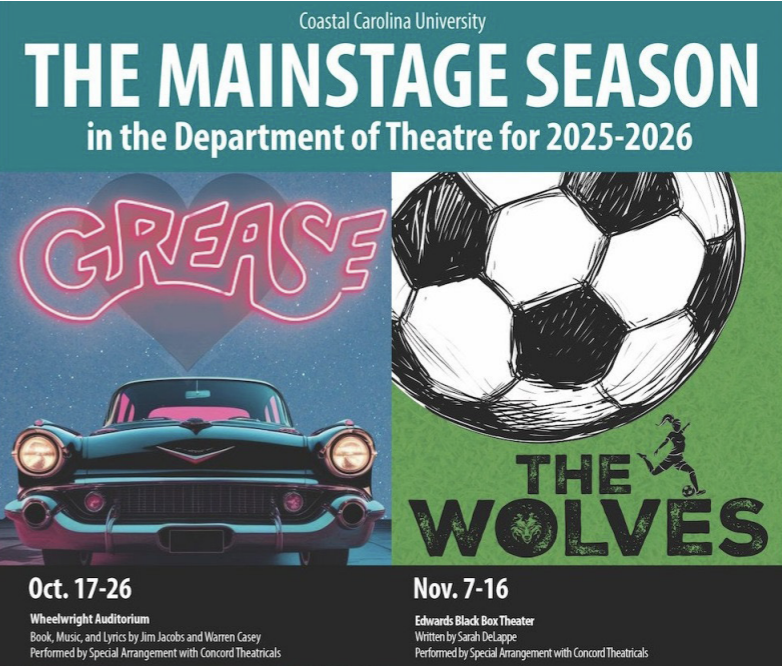
Coastal Carolina University’s Theatre Department has faced criticism after utilizing AI technology in the 2025-2026 mainstage season promotional poster designs.
The department posted a variety of posters on Instagram on Aug. 4, prompting negative feedback from students, alumni and others who said the appearance of AI influence represented a decision to overlook human artistry.
Department Chair and Theatre Professor Steven Higginbotham said the urgency for design production played a major role in the decision to use AI-supplemented tools along with graphic design tools.
“In terms of thinking about the season’s posters, we really wanted the posters to align with the conceptual approach to each of the shows and to fit within the timeline that we had,” Higginbotham said.
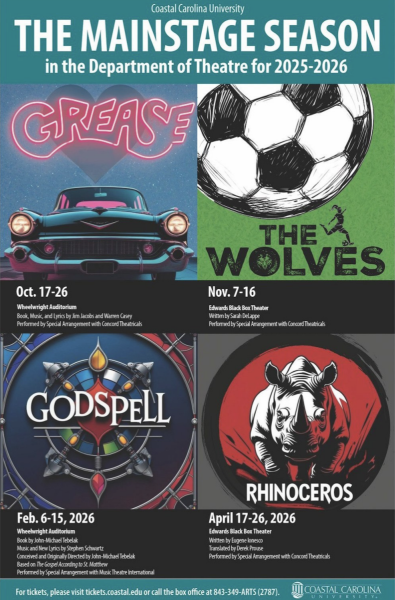
Critics pointed out how the department is part of the Edwards College of Humanities and Fine Arts, full of students trained in graphic design, illustration and other creative work.
Senior BFA Design and Production major Erin Poinsette said the AI posters felt dismissive of students’ abilities.
“You have art students. You have graphic design students who are planning on doing this. And by using AI in the posters, it just feels like a huge slap in the face,” she said.
She also said the use of AI-enhanced art designs could discourage potential students from attending CCU.
“We’re here to educate ourselves in order to do a job that we love. And in doing so, using AI generated images to promote the department is essentially discouraging,” Poinsette said.
Higginbotham said the posters were not entirely AI-generated.
“I think we used some tools, a lot of graphic design tools, and some AI supplemented tools, in order to create the logo images. And I made that decision,” he said.
Poinsette redesigned the four posters herself to prove students are capable. Using 24 layers in Procreate, she submitted a fully human-made version of the “Grease” poster. The board ultimately decided to continue using the AI-enhanced posters, since they had already been used for promotion.
Faculty have expressed their concerns as well. Professor of English Joe Oestreich said AI shortens the creative process.
“The most important thing is the process to get between the idea and the product. And so, what AI does is it allows you to completely eliminate the process and just skip straight to the product,” Oestreich said. “I think it’s just a situation where all departments should remind themselves that the students are a tremendous resource.”
Acting Professor Matthew Schneck, director of “Rhinoceros,” an upcoming spring production, said students’ complaints could seem inconsistent if they use AI elsewhere.
“I do find people upset about the posters a little hypocritical if they use ChatGPT, or any form of AI to do their assignments. Because you are —it’s philosophically the same thing — you are using it and then upset about it,” he said.
CCU Theatre responded publicly to the backlash in an Instagram post published on Aug. 6. According to the statement, the department said AI images were combined with human edits and guided by directors’ artistic visions, a process “never intended to replace human artists.”
Higginbotham said the department plans to move toward stronger student involvement.
“We share the students’ belief and alumni belief, and the irreplaceable value of human artistry. Going forward, we are actively working to establish sustainable partnerships with CCU’s arts programs to ensure more student involvement in this,” he said.
He added that student feedback played a major role in the department’s response.
“We’ve heard from our students and from our alumni that this is something that is very important to them. To make sure that the artwork in our department is created fully by human hands,” he said. “We take that as being a powerful sentiment, and we work forward in a way that honors that sentiment.”
The controversy has shown the tension between efficiency and hands-on learning in creative fields. Students said they want opportunities to design, problem-solve, and express themselves.
CCU Theatre has not announced any plans to replace the AI posters, which remain part of the marketing for the 2025-2026 season.