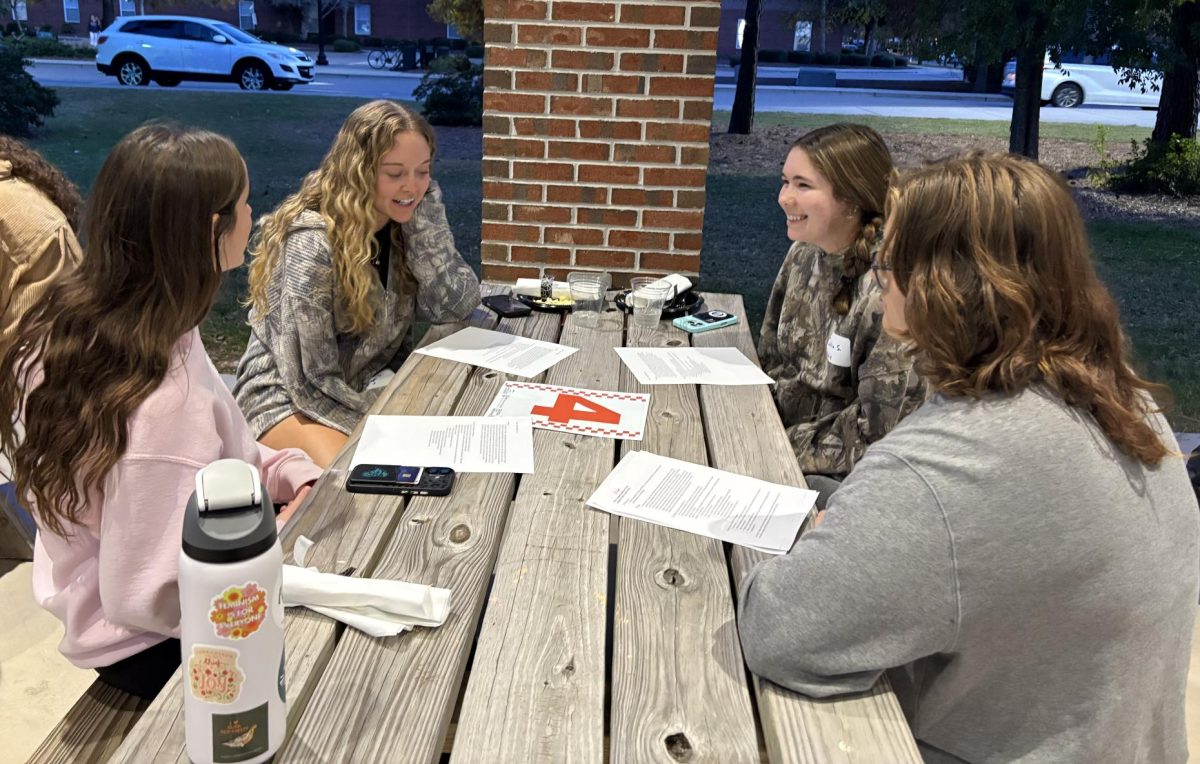
The Coastal Civic Initiative opened the floor to student-led dialogue on a range of controversial topics at a Civic Cookout on Thursday, Nov. 11, kicking off their approach to creating an atmosphere of unity and respect.
The newly established Coastal Civic Initiative is carried out through the Center of Applied Civic Leadership (CACL) and housed under the HTC Honors College. CACL Director Justin Vaughn and Dean of HTC Honors College Sara Hottinger created the initiative together, responding to calls for campus proposals that develop and build a civic pluralism strategy.
“It really is an initiative meant to bring our campus closer together and in conversation with each other, but I think it’s also a response to some of the really deep political divides that we see right now in our country,” Hottinger said. “Our hope is that the more faculty, staff and students that we can get together, who can have conversations with each other — even if they agree to disagree on whatever the issue might be — the healthier we’ll become as a nation.”
Vaughn expanded why launching the initiative now is more important than ever.
“Universities are the perfect place to equip students, not just with the skills they need to be successful professionally, but also to be effective and engaged citizens,” Vaughn said. “I think that’s always been true, but recently it’s become even more true, as you know, we see the civic culture of the United States become increasingly hostile and coarse.”
He added the importance of focusing on Gen Z students, who he said are increasingly unwilling to participate in civic dialog.
“You all have lived your entire life in this digital era that’s been characterized by overwhelming polarization and toxic political discourse, so there’s no kind of role model out there in society, really, to look to and pick it up on your own,” Vaughn said. “Which makes it increasingly important for us as a campus community to help you all develop those skills, develop desire to practice those skills.”
Coastal Carolina University was one of 10 universities across the nation to be selected into the Advancing Campus Pluralism cohort, developed in collaboration by Interfaith America and the American Association of State Colleges and Universities. Each university chosen received a $25,000 grant to fulfill their campus initiative with a common goal of unity.
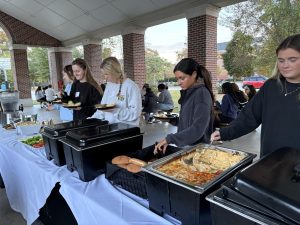
After months of strategic plan approvals and training, the initiative launched their Civic Cookout. Freshmen of the HTC Honors College were invited to the Tradition Pavilion to embrace different perspectives while enjoying grilled hot dogs and burgers, potato salad and creamy mac and cheese.
Divided into randomized groups led by student-facilitators, after casual conversation and icebreakers, Hottinger explained how the event’s purpose was not to debate, but to learn how to engage with an open mind in conversations that may seem uncomfortable.
“The goal for you is not to be right. No one is going to be right on these issues,” Hottinger said. “These issues are controversial enough, or have enough different perspectives surrounding them, that you can have your own perspective and it’s going to be just as right as the person across the table from you whose perspective is very different; and that’s okay.”
Each group was assigned one of three topics: social media use, artificial intelligence (AI) or free speech on campus. Conversations focused on the personal impact of social media use and government intervention with social media concerns, weighing potential cognitive and environmental costs of AI with innovative benefits or university policies and roles concerning free speech on campus.
Kimora White, a senior English major, said her group had plenty to talk about regarding free speech on campus. While not a freshman honors student, she was invited through her work with the Honors College to participate in the cookout as well.
“We had really good conversations, and we had some really good learning moments where we were able to just question the things around us and question the university’s role, and the role it’s supposed to have, in facilitating free speech but also protecting the rights of students,” White said.
White explained how the topic of free speech includes more than just protests, which some may quickly assume. She brought up Campus Conversations, a recent university launched initiative that allows students to directly interact with university leaders in an open forum.
“We think that the university does a good job of allowing students to speak up, but we think that it’s almost a bit inaccessible, like with the Campus Conversations going on. Usually they have those, but they’re usually, like, one or two nights at set time. It would be good if they had, like, a forum or an email where people could continue to just spread their opinions on things,” White said.
White was one of many who reported their group members having similar opinions, taking away from learning how to navigate difficult conversations.
“I do wish they [facilitators] would have played devil’s advocate a bit more just to help tease out like, these thoughts that we actually have. Because, of course, no matter how much they say, ‘this is a safe space,’ people are still going to be reserved. If you really want to get those real beliefs and opinions, we’re going to have to, like, help them a bit,” she said.
Group facilitator Jamya Davis, a senior sociology major, said although her group didn’t face much disagreement, members effectively shared different perspectives on social media effects and regulations.
Both Davis and White see great potential in growing initiative events for a larger group of students, such as the possibility of including more diverse perspectives.
“I think that would be a really good way, because I feel like a lot of people are not able to have certain conversations without feeling the need to be defensive,” Davis said.
White shared a similar viewpoint, adding how events such as this help break down the defensive mentality.
“I think we should definitely do it again, especially because I think these topics are really touchy, but they don’t really have to be,” she said.
Vaughn explained how the event was open to honors freshmen specifically because the Coastal Civic Initiative center is located in the honors college, where it had already received general attraction. By keeping the launch event small, he said they could appropriately gauge student reactions and prepare for bigger events in the spring.
Overall, Vaughn and Hottinger welcomed constructive criticism and felt the cookout was a success, looking forward to growing the initiative in the spring.
“The students talked the full time about the things I think they’re supposed to be talking about, and so I think that’s a success. It wasn’t like in 10 minutes they were talking about final exams, or, like, the Kardashians or something,” Vaughn said. “So, I think it’s a good experience, and I think some evidence that people are not only willing, but also interested in having these conversations, even though there’s some apprehension about doing it.”