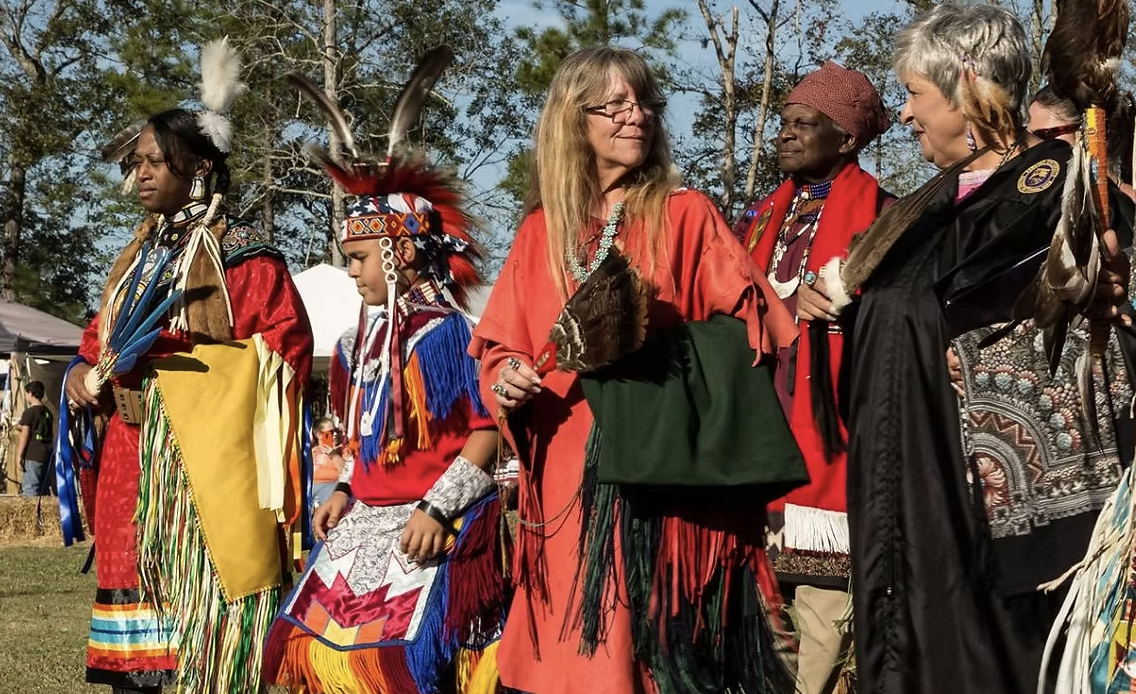
Drums echoed across the tribal grounds as dancers in traditional regalia entered, marking the start of the Waccamaw Indian People’s annual Pauwau in Dog Bluff, South Carolina.
The Waccamaw recently hosted their annual Pauwau, a two-day event featuring fire dances, craft-making, storytelling and drum circles.
Such a large event takes about a year of planning and coordination with local government officials, with volunteer recruitment from Coastal Carolina University and Horry-Georgetown Technical College being one of the most vital parts.
The Waccamaw are descendants of a group that lived and farmed in what is now Dog Bluff in Aynor, South Carolina. They received official recognition from the state in 2005 but are still battling with the federal government for recognition.
Caila Andrukevich, a senior anthropology major, volunteered at the event for the first time.
“I grew up going to Pauwaus, you have to love it, it’s everything. Just going out, talking to people, recording their stories and keeping that culture alive is what makes anthropology important,” Andrukevich said.
Carolyn Dillian, an anthropology professor at Coastal, has been working with the Waccamaw tribe since joining the university in 2010. Dillian has led archeological excavations, historical research projects and volunteered during the Pauwau every year.
Through her work, Dillian has been recognized as a member of the tribe or a Hunka, meaning relative by choice.
“These are our neighbors, friends, colleagues and classmates so they are a part of our community and it’s important for everyone to educate themselves about our neighbor’s culture. They are the descendants of the ancestors who lived here years ago,” Dillian said.
Faculty members across CCU’s campus have started to include a land acknowledgement for the Waccamaw tribe and their traditional territory, which is land where Coastal was built. This is a part of a working relationship between university faculty and the tribe.
The acknowledgment reads, “The land on which Coastal Carolina University stands is part of the traditional territory of the Waccamaw Indian People. We honor them and express our gratitude to the ancestors who lived here in the past, the Waccamaw Indian People today, and to the generations to come.”
The Waccamaw Indian tribe is led by Chief Buster Hatcher who prioritizes community involvement while staying true to their culture.
“We center a lot on drumming and sacred eagle, owl and hawk feathers which are illegal although it is our culture,” Chief Hatcher said. “We are the only people that must prove who we are, and the only people that have to be recognized.”